Imagine you spent the weekend cutting. The slope behind the house finally looks right, your arms are done, and there is a pile the size of a car sitting in the driveway. Your green waste bin holds maybe two percent of it, pickup is Thursday, and the pile is now the most flammable object on the property.
That is the moment brush hauling Chino Hills homeowners search for. This page covers what a haul-off includes, where the material goes, what tonnage and access do to the price, and how a pickup day runs.
What is included in brush hauling Chino Hills pickups?
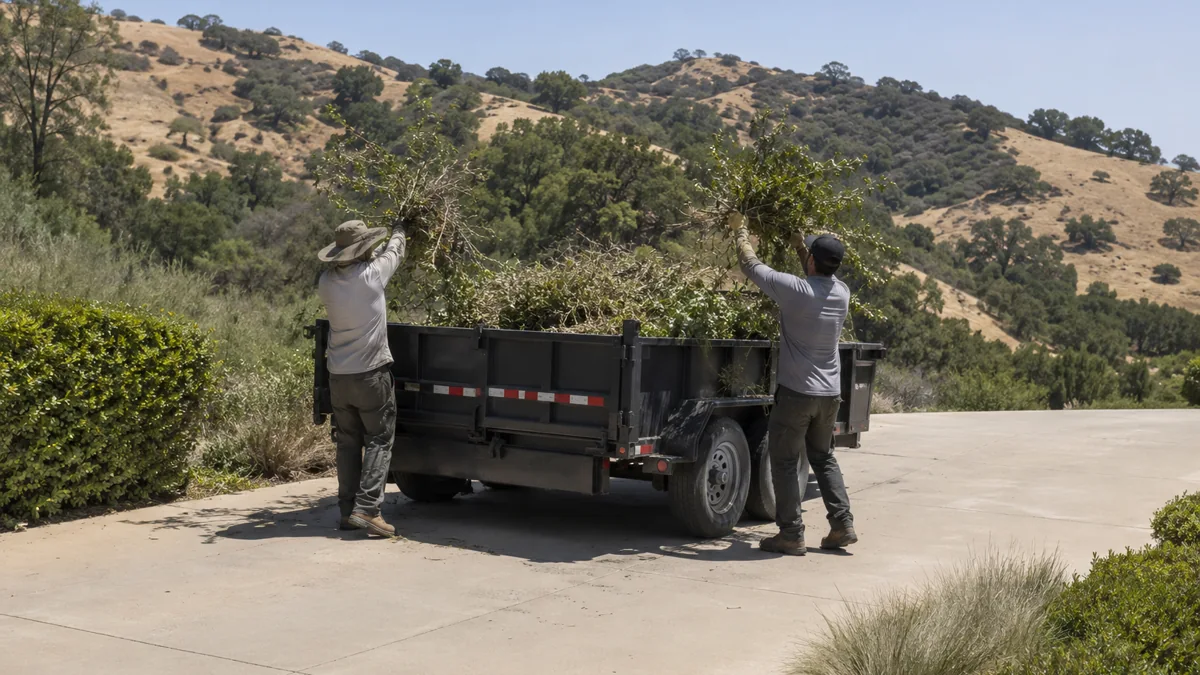
Hauling is the removal half of a clearing job, sold on its own. You cut it, we take it away, and the parcel ends clean.
A standard haul-off covers:
- Loading cut brush, branches, palm fronds, and bagged weeds from wherever they are staged
- Raking and sweeping the staging area so the driveway or pad is left clean
- Chipping bulky woody material on site when volume justifies it
- Transport in a dump trailer or dump truck
- Disposal at a green waste recycling facility, with weight tickets available on request
We also pick up the material nobody plans for: tumbleweed piled against a fence after a wind event, palm fronds dropped across a yard, and the leaves and pine needles cleared off roofs and out of gutters, which the Fire Hazard Overlay District specifically expects owners to remove.
If the pile is bigger than one truck, we say so before we start rather than after.
When does a pile need a truck instead of your green waste bin?
Curbside bins handle lawn clippings and a few branches. They do not handle a clearing job. A haul makes sense when:
- The pile is taller than waist height or wider than a parking space
- Material is woody, thorny, or full of palm fronds that will not compress into a bin
- An abatement deadline is close and you cannot wait six weeks of bin cycles
- The pile sits next to a structure, a fence, or a slope, where it is now a fuel hazard on its own
- The material is tangled with trash, wire, or dumped debris and needs sorting
- An escrow, a lender, or an insurance inspection needs photos of clear ground
A cut pile left through summer is worse than the standing brush was. Cured, stacked, dry material next to the house is exactly the fuel arrangement the clearing was supposed to eliminate.
Where does the material actually go?
Clean green waste goes to a recycling or composting facility rather than a landfill. Brush, branches, grass, and leaves get processed into mulch and compost, which is why keeping the load clean matters so much to the price.
Chipping on site is the other option. A chipper turns bulky brush into a fraction of its volume, and the chip can stay on the property as mulch on open ground. Chip is kept away from the immediate zone around structures, where a deep layer would just become fuel again.
Loads with trash mixed in cost more, because facilities charge differently for contaminated material and the sorting is done by hand. Tires, treated lumber, painted wood, and construction debris all have to be separated and routed elsewhere.
Ask for weight tickets if you need proof of disposal for an association, a lender, or your own records. We keep them.
What changes the price of hauling green waste?
The brush hauling Chino Hills crews quote is priced on volume, weight, and how hard the material is to reach.
- Tonnage. Disposal is charged by weight at the facility, and green material fresh off a cut is heavy with water.
- Volume and truckloads. Two trips cost roughly twice what one does, because time and dump fees both repeat.
- Access. A pile in the driveway loads fast. A pile behind a five-foot gate at the bottom of a slope gets carried out armload by armload.
- Material type. Palm fronds, cactus, and thorny brush load slowly and pack badly.
- Contamination. Trash mixed into green waste raises both the labor and the dump rate.
- Chip versus haul. Chipping on site reduces trips and usually lowers the total.
Green waste haul-off in this region commonly runs about $300 to $800 per truckload, with small driveway piles below that and multi-load parcels well above it. Clean, accessible, pre-staged piles always price better than scattered material.
What does haul-off day look like?
We confirm where the truck can park before we arrive, because that decides the whole day. On narrow hillside streets and in the canyon, staging space is the real constraint.
Crews load early, following fire district guidance to run powered equipment before 10 a.m. where a chipper is involved. Expect a couple of hours of engine noise if we are chipping, and less if it is a straight load-and-go.
Most single-pile residential jobs are done in two to four hours. Multi-load parcels take a full day, with the truck cycling to the facility and back.
Before we pull out, the staging area is raked, the driveway is swept, and there is nothing left in a corner for you to deal with later.
Timing counts. Vegetation must be cleared by May 5 under the Chino Valley Fire District's annual program, and a pile of cut material still sitting on the parcel is not a cleared parcel. Confirm the current cycle with the Chino Valley Fire District.
Where do we pick up brush around the valley?
We run haul-offs across the valley, from hillside driveways in Chino Hills to open acreage and equestrian properties in Chino, where a single wind event can stack tumbleweed four feet deep against a fence line.
Plenty of people call for hauling and find out the cutting is the bigger job. If the material is still standing, start with brush and overgrowth removal and we will price the cutting and the haul together. Whole vacant parcels usually need full lot and land clearing instead, since a pile-by-pile approach gets expensive fast.
Send a photo of the pile with something in frame for scale through the contact form, or call and describe what you cut. That is usually enough to size the truck and give you a real number.
Common questions about brush hauling
Do I have to stage the pile before you arrive?
You do not, but it lowers the cost. A single pile near the driveway loads in a fraction of the time that scattered material takes. If the brush is still spread across a slope or a back lot, tell us when you call so the quote reflects the collection labor rather than just the truck.
Can you haul palm fronds and cactus?
Yes. Both are common here and both are slow to handle, so they usually price above ordinary brush. Palm fronds pack badly and take up truck volume out of proportion to their weight. Cactus needs careful handling and separate staging. Neither is a problem, they just take longer.
How much brush fits in one load?
A dump trailer typically takes a pile roughly the size of a compact car once material is compressed or chipped, though loose leafy brush fills space faster than tight branch bundles. Send a photo with a trash can or a car in frame and we can usually tell you whether it is one trip or two.
Will you take trash mixed in with the brush?
Usually yes, but it changes the price. Clean green waste goes to a recycling facility at one rate. Loads with tires, treated lumber, or household trash get sorted by hand and routed to different disposal, which adds labor and dump cost. Flag it when you call so nothing stalls on the day.
Do I get proof the material was disposed of properly?
Yes. Ask for weight tickets from the disposal facility and we will send them with the invoice, along with before and after photos of the staging area. Associations, lenders, and out-of-area owners generally want that record, and it is easier to collect on the day than to reconstruct later.