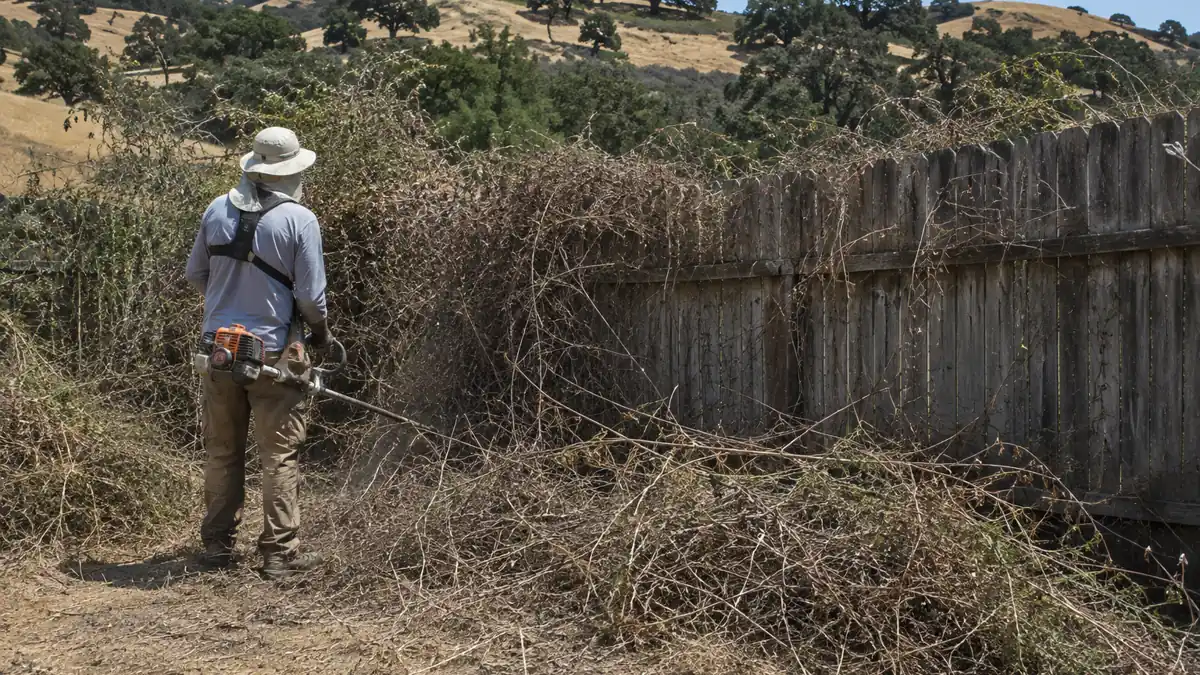
Imagine walking your back fence line in late June. The mustard is taller than you are, there is a gray tangle of last year's growth locked under the green stuff, and a solid wall of dry material stands about three feet off your wood fence. Nothing about that yard is usable, and all of it burns.
That picture is behind most calls for brush removal Chino Hills homeowners make. The brush clearing Chino Hills properties need each spring is this same work under a different name. This page covers what actually comes out, why it grows back so fast here, what the law says before you cut, and what the job costs.
What comes out during a brush removal Chino Hills cleanup?
Brush removal takes out the woody, tangled, multi-year growth that a mower cannot touch. It is a cutting and extraction job, not a trim.
A typical scope includes:
- Cutting standing brush and saplings down at or near ground level
- Pulling dead wood, old canes, and years of accumulated dry litter out of the stand
- Clearing growth back off fences, block walls, sheds, HVAC units, and play structures
- Cutting back overhanging limbs that shade and feed the tangle
- Chipping on site or loading everything out, depending on your parcel and budget
What we normally leave is root structure and any healthy specimen tree or shrub worth keeping. Grubbing stumps and roots out is a separate, heavier operation and it is rarely what a homeowner actually needs to reduce fire risk.
Cleared right, a fence line goes back to being a fence line and you can see your own property again.
How do you know the overgrowth has gone too far?
Most people wait a season too long. These are the practical triggers:
- Brush is physically touching the house, the fence, the eaves, or a detached garage
- Grass and weeds ran past knee height in May and have already cured brown
- You can no longer walk your own property line
- A vacant lot beside you is drawing complaints, or your own lot is
- An abatement notice arrived from the fire district
- An escrow or an insurance underwriter is asking for photos of cleared ground before the deal or policy moves
Insurers writing in hazard zones now look closely at brush exposure. A heavy stand pressed against a structure is one of the fastest ways to draw a non-renewal letter, and the fix is usually a single day of cutting.
Why does the brush come back so fast in this valley?
The Chino Valley runs on a boom and bust water cycle. A wet winter loads the ground with seed and a heavy crop of annuals, then five dry months turn all of it into standing dry fuel by June.
Most of what fills a neglected yard here is not native chaparral. It is black mustard, wild oats, and Russian thistle, which is the tumbleweed that stacks against your fence in November. Castor bean colonizes disturbed ground and drainage channels fast. Along the hillside edges, laurel sumac and buckwheat come in from the open ground.
Those annuals regrow from seed every single year, which is why brush work here is a recurring maintenance item rather than a one-time project. A parcel cut clean this spring can be shoulder-high again fourteen months later.
The upside is that a maintained parcel is far cheaper to keep than an abandoned one is to reclaim.
What rules apply before brush comes out?
Two things shape the timing of a large clearing job around here.
First, the fire calendar. The Chino Valley Fire District requires combustible vegetation cleared by May 5, with a reinspection on June 11 and penalties behind it, so most owners want brush down well before summer.
Second, birds. Large clearing jobs during nesting bird season, roughly February 1 through August 31, may need a pre-clearing survey under state and federal bird protections. That matters most on big untouched parcels and along the open ground near Chino Hills State Park, where active nests are genuinely likely. Guidance lives with the California Department of Fish and Wildlife.
The two rules pull against each other, which is exactly why the smart window for heavy brush work on a large parcel is late fall through January.
What drives the price of a brush removal job?
The price of brush removal Chino Hills crews quote tracks density and disposal, not lot size.
- Stem thickness. Soft annual growth cuts in minutes. Woody stands with years of growth cut slowly and dull chains.
- Volume. A pickup load and a 30-yard pile are not the same job, and disposal is charged by weight at the recycler.
- Access. If a chipper and a dump trailer can park within a drag of the work, cost drops. Backyards behind a narrow gate mean everything gets carried.
- Slope. Steep ground turns a machine job into a hand job.
- Contamination. Trash, wire, and dumped debris tangled into brush must be separated before the green waste can be recycled.
A typical residential brush removal in the Inland Empire runs roughly $700 to $3,000, with light fence-line work landing below that and neglected quarter-acre tangles landing above. We quote after we see it, never over the phone from a description.
What does removal day look like, and how does the lot end up?
Crews cut early, following fire district guidance to run mowers and trimmers before 10 a.m. and never to mow dry vegetation with a lawn mower. Expect chainsaw and chipper noise in bursts, plus dust when the ground is dry.
Material moves in one direction, from the stand to the staging point to the truck. Nothing gets pushed into a corner or over a back fence onto open ground.
Most residential jobs finish in one day. Heavy parcels needing multiple truckloads run two. When we finish, the ground is cut low, dead material is off the site, structures and fences have clear space around them, and the soil still has roots in it.
Big piles are their own problem, and hauling the green waste off site is often quoted as its own line. If the work runs onto a grade, look at how we handle clearing on steep ground.
Where a whole parcel is involved rather than a fence line, the job crosses into lot and land clearing and gets priced by the acre instead of by the pile.
We cut across the valley, from yards and hillside lots in Chino Hills to the larger hillside properties in Diamond Bar. Send photos through the contact form or call, and we will schedule a walk-through.
Common questions about brush removal
Do you take the brush away or leave it on site?
Both options exist. Chipping on site returns material as mulch and costs less, which works well on large parcels with room for it. Full haul-off to a green waste facility costs more because you are paying for truck time and disposal weight, but it leaves the lot genuinely clean.
Will the brush grow back next year?
The annual weeds will, because they regrow from seed after every wet winter. Woody brush cut at the base regrows more slowly and stays smaller each cycle if it is cut on schedule. Most properties here settle into one maintenance visit a year, timed before the spring deadline.
Can you clear brush right up against my fence and house?
Yes, and that is the highest-value clearing on the property. Vegetation touching a wood fence or an eave gives fire a direct path to the structure. Crews hand cut against fences, walls, meters, and utility boxes rather than running machines up to them.
How long does a typical brush removal take?
A fence line or a small backyard is a half day. A neglected quarter-acre with heavy woody growth and full haul-off usually takes a full day, sometimes two if the material needs several truckloads. Access is the biggest variable, since carrying material by hand doubles the labor.
Is there a best time of year to clear heavy brush?
Late fall through January is ideal on large parcels. The ground is soft, fire risk is lower, and you avoid the heart of nesting bird season that runs roughly February 1 through August 31. Residential yards get cleared in early spring so they are clean before the May deadline.