Who is responsible when the vacant lot next door grows five feet of mustard and starts dropping tumbleweeds into your yard? In this city the answer is the parcel owner, and the fire district will put it in writing.
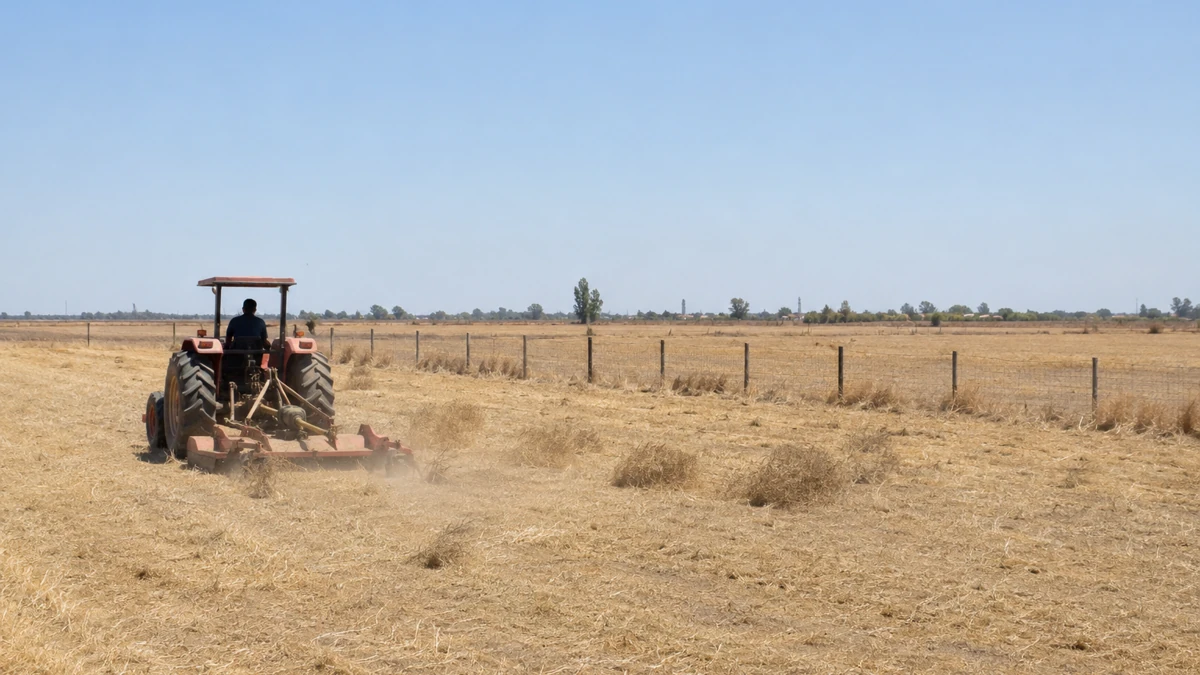
Land clearing Chino CA property owners need looks nothing like the hillside work a few miles south. This is flat-ground country: open fields, vacant parcels, equestrian lots and land waiting on a building permit. Most of it gets mowed and disced, not hand-cut off a slope.
What makes land clearing Chino CA lots different from hillside work?
Chino sits on the flat floor of the Chino Valley, not on the hills that wrap the city to the south. The fuel here is annual grass, mustard, castor bean along the ditches and Russian thistle on disturbed ground — light, fast-growing and spread across wide open parcels.
That changes the equipment. Where a hillside crew works by hand off a steep drop, a flat parcel here gets a tractor with a flail mower or a disc, and an acre disappears in an afternoon.
It also changes the customer. Half the work in this city is not somebody's back yard. It is an absentee lot owner, a ranch property, an HOA-maintained field, or a developer holding land between entitlement and groundbreaking.
Who enforces weed abatement in Chino, and when is it due?
Chino is served by the same agency as Chino Hills: the Chino Valley Fire District. Its annual weed abatement program covers improved and unimproved parcels in both cities, and the calendar is identical on either side of the line.
Combustible vegetation has to be cleared by May 5. A parcel still hazardous at the June 11 reinspection draws a $300 non-compliance penalty, and if the district sends its own contractor, the owner is billed for the clearing plus a $328 administration fee.
Those figures are set for each program year. Check them against the Chino Valley Fire District before you schedule around a date.
Absentee owners get caught by this constantly. Notices go to the address on the tax roll, and by the time the mail forwards, the reinspection has already come and gone.
Why does tumbleweed keep coming back on Chino lots?
Russian thistle — tumbleweed — thrives on exactly the ground this city has: disturbed soil, graded pads, fence lines and fallow fields. It grows through spring, dries into a hollow ball, snaps off at the root and travels with the wind.
Once it piles against a fence, a block wall or a building, it becomes a wick. A dry tumbleweed pile carries flame straight to whatever it is leaning on, which is why fire crews treat accumulation as an active hazard rather than a housekeeping problem.
The fix is timing, not effort. Cut it while it is still green and rooted and it never tumbles. Wait until August and you are not clearing a lot anymore, you are chasing it across the neighborhood.
Vacant parcels, equestrian lots and land waiting on a permit
Chino's rural-residential and equestrian pockets bring their own version of the job: pasture edges, arena perimeters, barn surrounds and the strip along the property line nobody mows. Fire clearance and horse safety point the same direction — cut it, rake it back and haul it out.
The legacy dairy preserve land is a different story. As those parcels convert to logistics buildings and housing, they need lot and land clearing before survey crews, geotech rigs and grading equipment can work: vegetation down, debris out, ground visible.
Parcels held long term get annual abatement mowing and discing on a set schedule, so the notice never arrives at all. Every job should end with the cut material hauled off instead of piled in a corner where it becomes next year's fuel.
What affects the price of clearing a lot in Chino?
Flat ground is the cheapest terrain in this market to clear, which is good news for Chino owners. The price of land clearing Chino CA parcels still moves on a handful of factors:
- Acreage, and whether a mower can run continuous passes or has to work around structures, poles and irrigation
- How tall and how woody the growth got before anyone called
- Whether material is mowed and left in place or cut, loaded and hauled by weight
- Debris already on the parcel — dumped furniture, tires and construction waste come out before a mower runs
- Gate width and access, since a tractor that cannot fit through the gate turns the job into hand work
Expect per-acre pricing on open parcels and a flat quote on residential lots. Across Southern California, mowing clean and accessible acreage typically runs a few hundred dollars per acre, and climbs from there with density, debris and haul-off.
What does clearing day look like on a flat Chino parcel?
Crews run early. Fire district guidance is to mow and trim before 10 a.m., while fuel moisture is still up, and never to cut dry vegetation with a standard lawn mower — a blade strike on a rock is a common ignition source in exactly this kind of field.
On an open parcel, expect dust. A one-acre mow is usually a half-day; multi-acre discing with haul-off runs longer, and a wind hold on a red flag day can move the date.
Large clearing on undeveloped ground during nesting bird season, roughly February 1 through August 31, may call for a pre-clearing survey under state and federal bird protections. Ground-nesting species use fallow Chino fields, so raise it before a wide parcel gets mowed in spring.
Own a parcel on the Chino Hills line?
Parcels at the south end of the city run up against terrain that behaves like the hills: rising ground, heavier brush and real slope. Those get quoted as hillside brush clearing, not field mowing. See how we handle the hillside side of the valley if your lot sits on a grade.
Either way the deadline is the same and so is the enforcing agency. Browse the rest of the Chino Valley communities we clear if you hold property in more than one city.
Get your Chino lot on the schedule
Book before April. Call for a free estimate on your parcel, or send the form below with the address and rough acreage. Quoting flat ground is quick, and clearing it early costs far less than a penalty plus an administration fee.
Questions from Chino property owners
Who is responsible for clearing a vacant lot in Chino?
The property owner of record is responsible, whether the parcel is built on or empty. The Chino Valley Fire District mails notices to the owner listed on the tax roll and re-inspects later in the season. If the parcel is still hazardous, the district can have its own contractor clear it and bill the owner for the work plus an administration fee.
How often does a Chino field need to be mowed?
Most open parcels in Chino need at least one clearing before the May deadline and a second pass in mid-summer if rain kept growth going. Tumbleweed-prone ground often needs an earlier spring cut while the plants are still rooted, because once they dry and break loose they spread across neighboring properties.
Do you clear construction sites before grading?
Yes. Pre-construction lot clearing removes standing vegetation, brush and surface debris so survey, geotechnical and grading crews can work on visible ground. On former agricultural and dairy-preserve parcels in Chino, that usually also means hauling off years of accumulated growth and dumped material rather than just mowing it flat.