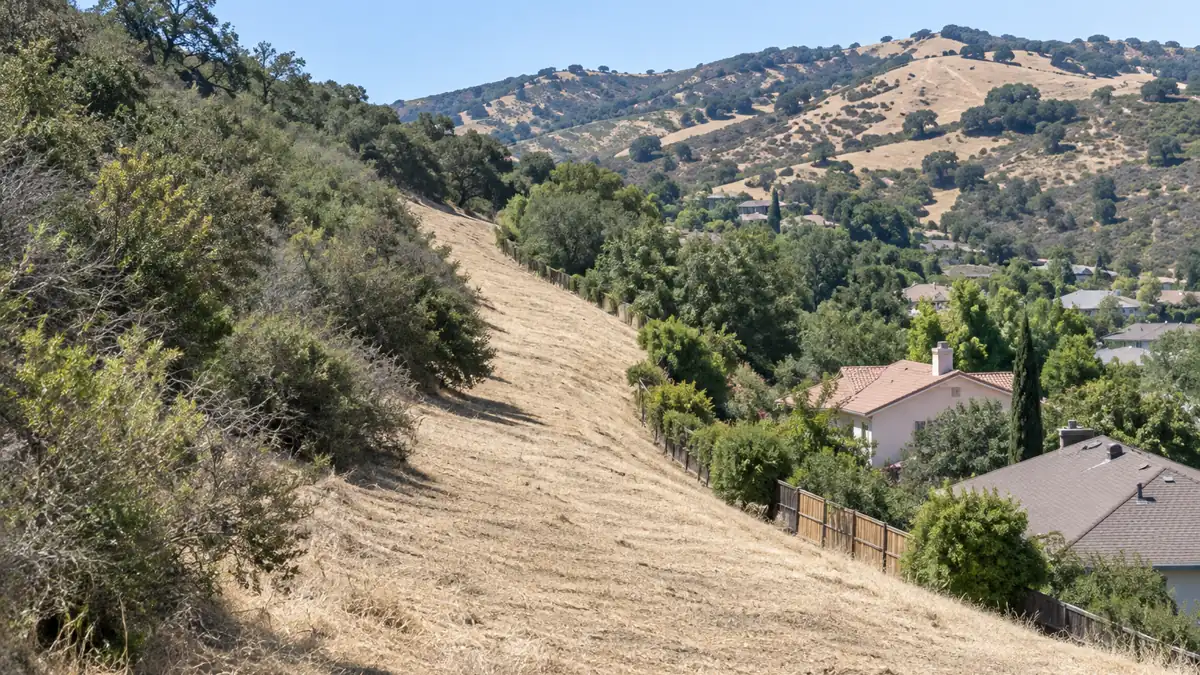
In November 2008 the Freeway Complex Fire burned 30,305 acres, destroyed 187 homes and damaged 127 more, and consumed roughly 95% of Chino Hills State Park before running through Carbon Canyon into Chino Hills and Diamond Bar. That is the fire this city plans around.
It is also why fuel modification Chino Hills properties carry is not landscaping. A fuel modification zone is an engineered buffer between open wildland and the first row of houses, and it only works if somebody maintains it every single year.
What is fuel modification in Chino Hills, and how is it different from defensible space?
They overlap, but they are not the same job.
Defensible space is measured out from a building. It is the homeowner's 100 feet, focused on protecting one structure.
Fuel modification is measured from the edge of a development. It is a wider, planned band of treated vegetation between the wildland and the whole tract, usually designed when the community was approved and maintained by the HOA, the property owner, or a district.
A fire break is the narrowest version of the idea: a strip cut down to short stubble or bare ground that gives crews a place to stand and stops a running grass fire from crossing unbroken.
Most hillside tracts on the edges of this city have all three at once. The homeowner handles the yard, the association handles the slope band, and the interface with open ground behind it is the piece that gets forgotten.
All three sit inside the same land clearing trade. They just answer to different owners, which is why one gets maintained and another sits untouched for years.
What does a working fire break look like on the ground?
It is not a scraped dirt road. A properly maintained zone is a gradient.
- Closest to structures, grass is cut low and dead material is gone entirely
- Through the middle band, brush is thinned into separated islands with space between the canopies
- Along the outer edge, taller vegetation is limbed up so there is no ladder from grass into shrubs into tree crowns
- Dead wood, cured annual growth, and leaf litter are removed from all three bands
The idea is to break continuity. Fire moves through connected fuel, so a zone that separates fuel horizontally and vertically slows a fire front and drops its intensity before it reaches a fence line.
Root systems stay in the ground. On the slopes above Carbon Canyon Road, stripping a break to bare dirt trades a fire problem for a winter erosion problem, and both bills land on the same owner.
How often does a fuel modification Chino Hills zone need maintenance?
Once a year at minimum, and the calendar is not flexible here. Annual grass regrows from seed after every wet winter and cures by June, so a zone cut clean last spring is loaded again this spring.
Signs a zone has slipped past maintenance and into reclamation:
- Brush canopies have grown back together with no gaps between them
- Dead material has built up under live shrubs
- The break line is no longer visible from the street or the fire road
- Vegetation has crept back toward fences and rear walls
- An abatement notice or an HOA violation letter has arrived
A maintained zone is a mowing and thinning visit. A zone skipped for three years is a brush clearing project at several times the price, which is the single most common budget mistake associations make on these tracts.
Who sets fuel modification and fire break requirements here?
Requirements come from more than one place, which is why owners get confused.
The Chino Valley Fire District runs the annual weed abatement program, and its cycle drives the schedule: combustible vegetation cleared by May 5, with a $300 non-compliance penalty at the June 11 reinspection and a $328 administration fee if the district's contractor does the work.
Properties in the Chino Hills Fire Hazard Overlay District, which covers Vellano, Ridgegate, and the Carbon Canyon communities, carry additional defensible space requirements on top of that.
The city adopted Ordinance 2025-01, putting updated fire hazard severity zone maps in place for Chino and Chino Hills, so parcels that were outside a mapped zone before may be inside one now. Original fuel modification plans for a tract usually live with the association or in the development's approval documents.
Verify your zone and requirements through the City of Chino Hills. We work to published standards. We are not affiliated with any fire agency and cannot approve a plan on their behalf.
What affects the cost of fire break work?
The fuel modification Chino Hills crews maintain is priced by acre and by condition.
- Zone width and total acreage. A 100-foot band behind 30 lots adds up fast.
- Years since the last treatment. Maintenance is cheap. Reclamation is not.
- Machine access. Where a masticator can reach, cost per acre drops hard. Hand-crew-only terrain is the expensive case.
- Slope. Steep ground shifts hours from machine to labor and adds safety setup.
- Disposal. Chipping in place beats hauling on tonnage, but chip depth has to be controlled near structures.
- Weather windows. Red flag days stop powered equipment, and nesting bird season between February 1 and August 31 can require a pre-clearing survey on large untouched acreage.
Fuel modification maintenance in this region commonly runs about $1,500 to $4,000 per acre, with well-maintained zones at the low end and multi-year reclamation above the range. HOA-scale work is quoted per zone after a walk of the whole boundary.
What happens when a crew maintains your fuel break?
The work starts at the boundary and moves inward, so cut material always travels toward the access road rather than toward the wildland.
Crews run early, following fire district guidance to work mowers and trimmers before 10 a.m. On hot, dry, windy days powered equipment stops and only hand work continues, because the last thing a fuel break should do is start a fire.
Expect masticator or chipper noise and heavy dust on the dry seasons. Acreage jobs take several days and get worked in bands, so a section is always finished rather than half-cut overnight.
When we are done, the break line is visible again, canopies are separated, dead fuel is out, and the ground still holds root structure for winter. We photograph each band so the association or owner has a dated record for its file.
Individual homes inside the zone still need their own clearance measured from the structure, and the steep sections almost always need a hand crew on the slope.
See how this plays out across the Chino Hills wildland edge and in the canyon communities along SR-142. Call or send your zone details through the contact form for a boundary walk.
Common questions about fuel modification
Is fuel modification the same as defensible space?
No. Defensible space is measured outward from a structure and is the individual owner's responsibility. Fuel modification is a wider planned band along the edge of a development, usually maintained by an association or a property owner as a group. Most hillside properties on this city's edge need both, and doing one does not satisfy the other.
Who is responsible for maintaining a fuel modification zone?
It depends on who owns the land the zone sits on. In many hillside tracts the band belongs to the homeowners association as common area, so the association contracts the maintenance. Where the zone crosses private lots, the individual owner is responsible. Your tract's original approval documents say which applies.
Can a fire break be cut to bare dirt?
Sometimes, on flat ground and along access roads. On slope it is usually the wrong call. A bare hillside sheds soil in the first winter storms, and the erosion repair costs more than the clearing. On graded terrain we cut and thin so root structure stays in place while the fuel load drops.
When is the best time of year to schedule this work?
Late fall through early spring. The ground is workable, fire risk is lower, red flag interruptions are rare, and you avoid the peak of nesting bird season that runs roughly February 1 through August 31. Waiting until late April means competing with every other parcel racing the May deadline.
Do you work with homeowners associations on multi-lot zones?
Yes. Zone work is quoted after walking the full boundary rather than by lot count, since condition varies section to section. Associations generally want a written scope, a per-band schedule, and dated photos for the file, and that is how we run acreage jobs.
Does clearing a fuel break guarantee my tract will not burn?
No, and nobody can promise that. A maintained zone lowers fire intensity, slows a fire front, and gives crews a place to work, which is a meaningful difference in outcomes. It is risk reduction, not a guarantee, and it works best combined with defensible space around each individual structure.