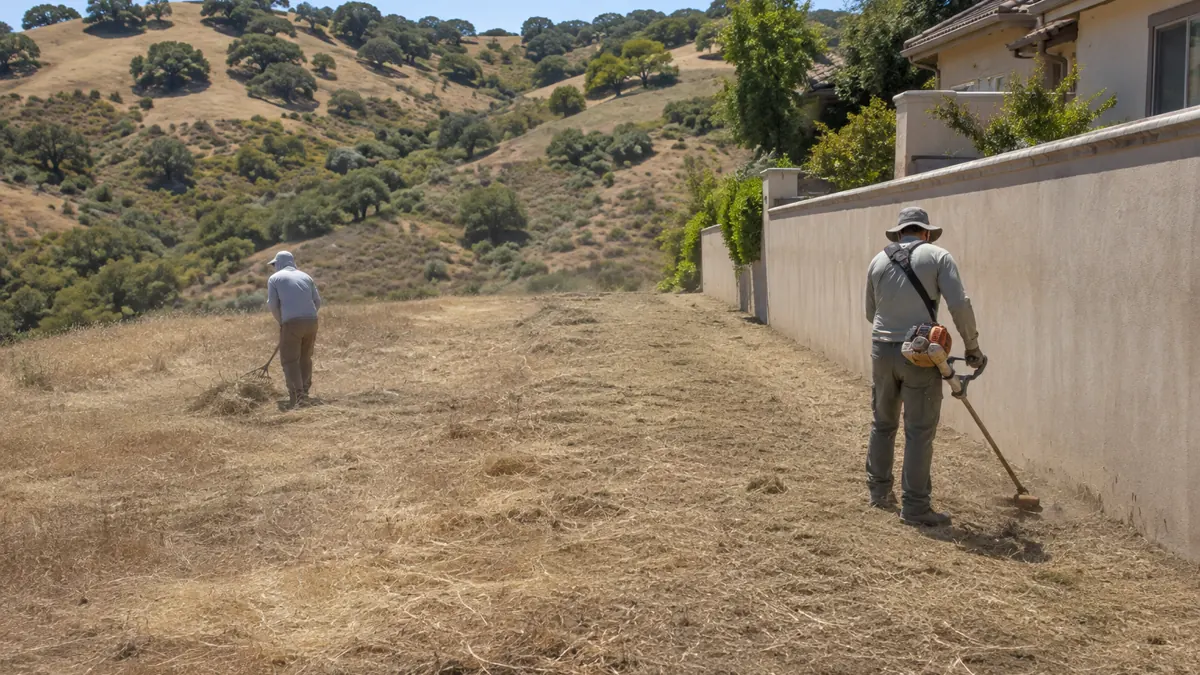
How far back does the brush behind your house actually have to be cut? For homes on the hillside side of town the answer starts at 100 feet, and that one number drives almost every defensible space clearance Chino Hills property owners pay for.
California law requires 100 feet of defensible space around structures in designated hazard zones, measured out from your walls across your own land.
This page walks through what that clearing looks like on a real lot here, who checks it, what it costs, and how a crew handles ground that drops away behind your back fence.
What does a defensible space clearance Chino Hills job include?
Defensible space work is structure-focused. The crew starts at your walls and works outward, pulling out the fuel that would carry flame from open ground to your siding, eaves, and vents.
On a normal residential job that means:
- Cutting annual grass and weeds low across the cleared zone
- Pulling dead brush, dead limbs, and dry leaf litter out from under living shrubs
- Breaking up solid stands of brush so fuel does not run in an unbroken line at the house
- Limbing branches back off roofs, eaves, chimneys, and wood fences
- Clearing leaves and pine needles from roofs and gutters
- Moving firewood, pallets, and stored clutter out from under decks and stairs
Clearing is not scraping a lot down to dirt. Bare soil on a slope here slides in the first hard rain. Spaced, green, irrigated plants near the house are fine. The goal is separation and dead fuel removal, not a moonscape.
Do the Fire Hazard Overlay District rules apply to your street?
Chino Hills layers extra requirements on properties inside its Fire Hazard Overlay District, which covers Vellano, Ridgegate, and the Carbon Canyon communities. If your address sits inside it, your checklist runs longer than the state minimum.
Overlay properties are expected to keep dead palm fronds removed, grass mowed to four inches or less, dead vegetation cleared out, leaves and pine needles off roofs and out of gutters, and combustible material out from under decks.
The city also adopted Ordinance 2025-01, which put updated fire hazard severity zone maps in place for Chino and Chino Hills. Maps change. A parcel that sat outside a hazard zone a few years back can sit inside one now, so check yours on the City of Chino Hills site instead of assuming the rules skipped your street.
Who enforces defensible space, and what happens if you skip it?
Two systems can reach you. State fire officials enforce the 100-foot standard under California's defensible space law. The Chino Valley Fire District runs the annual weed abatement sweep across Chino Hills and Chino on a fixed calendar.
That calendar has teeth. Combustible vegetation has to be cleared by May 5. Parcels still hazardous at the June 11 reinspection draw a $300 non-compliance penalty, and if the district sends its own contractor, the owner gets billed the clearance cost plus a $328 administration fee.
Insurance is the quieter enforcer. Carriers writing in hazard zones increasingly inspect brush exposure, and photos of heavy fuel sitting against a structure can trigger a non-renewal letter long before any inspector knocks.
We explain these rules and clear to them. We do not speak for any fire agency, and no contractor can promise you a passing inspection. You can read the state standard at CAL FIRE.
What affects the price of clearing 100 feet around a house?
Price follows the work, not the address. Two houses on the same street can differ by a factor of three because of what sits behind them.
- Slope and footing. A tractor or skid steer eats flat ground quickly. Steep ground means hand crews with chainsaws and weed whips, and hand time costs more per square foot.
- Access. A gate wide enough for a machine changes the entire plan. Narrow side yards and fenced canyon edges push everything out by hand.
- Vegetation type and density. Light annual grass cuts fast. Mature laurel sumac, castor bean, and years of dead material cut slowly.
- Green waste tonnage. Woody material means more truckloads and more disposal weight at the recycler.
- Scheduling. Red flag days shut powered equipment down, and every job pushed off a wind day compresses into the next open window.
For a typical hillside home, defensible space work in the Inland Empire commonly runs about $600 to $2,500 depending on slope, density, and how much material leaves the site. Larger canyon-side parcels run higher. Nobody honest quotes a number without walking the lot first.
Which Chino Valley neighborhoods need this work most?
Most of the defensible space clearance Chino Hills crews handle sits where houses meet open ground. Streets along the south and west edges of town back straight onto Chino Hills State Park, and the tracts above Carbon Canyon Road sit in a corridor that has burned more than once.
Santa Ana wind season makes that geography matter. Wind pushes fire downhill and across roads that look like barriers on a map, which is why the clearing distance is measured in feet from your wall and not in blocks from the wildland.
We cover the whole valley, and defensible space is one piece of the wider land clearing work these hillside parcels need. Look at how the work goes across Chino Hills neighborhoods, or at what changes on the narrow canyon parcels along SR-142.
What happens on clearing day?
Crews start early. Fire district guidance is to run mowers and trimmers before 10 a.m. and never to mow dry vegetation with a lawn mower, because a blade striking rock in dry fuel is a known ignition source. On hot, dry, windy days powered equipment stops and hand work continues.
Expect a few hours of noise and dust on a dry slope. Most single-home jobs finish in one day. Bigger parcels with heavy haul-off run two.
Cut material gets raked out from under shrubs, dragged to a staging point, and loaded. When we pull out, the grass is short, the dead fuel is gone, branches are off your roofline, and the root structure that holds your slope through winter is still in the ground.
Big jobs between February 1 and August 31 fall inside nesting bird season, so a pre-clearing survey may be needed under state and federal bird protections before heavy vegetation comes out.
If your parcel also carries a notice, the mowing and discing side of the job usually happens the same visit, and homes right on the wildland edge often pair this with ongoing fire break maintenance further out.
Tell us your address and what the notice says. Call or send the form on our contact page and we will walk the lot and price it.
Common questions about defensible space
Is 100 feet of clearance required on every Chino Hills property?
The 100-foot standard applies to structures in designated fire hazard zones, and it is measured out from the walls of the building. You are only responsible for the part of that distance that falls on your own land. If your property line stops at 40 feet, clear to the line and ask the neighboring owner to handle their side.
How often does defensible space clearing need to be redone?
Plan on once a year, done in early spring so the parcel is clean before the May 5 deadline. After a wet winter, fast-growing annual grass often needs a second cut in early summer to stay under the four-inch guidance used in the overlay district.
Can I do this myself instead of hiring a crew?
Yes on a small, flat yard with hand tools, worked before 10 a.m., and never mowing dry standing grass. Where homeowners get in trouble is steep ground, heavy woody brush, and material volume. A slope you cannot stand on comfortably is a slope you should not be running a string trimmer on alone.
Will clearing destabilize my slope?
Not when it is done correctly. Crews cut vegetation rather than grub it out, which leaves root systems and low ground cover holding the soil. Scalping a hillside to bare dirt is what causes erosion and washouts the following winter, so we cut and thin instead.
Can you guarantee my property passes fire inspection?
No contractor can promise that, and you should be skeptical of anyone who does. The inspector makes that call on the day. We clear to the published standards, then tell you plainly what is left on your list, such as gutter cleaning, roof debris, or items stored under a deck.