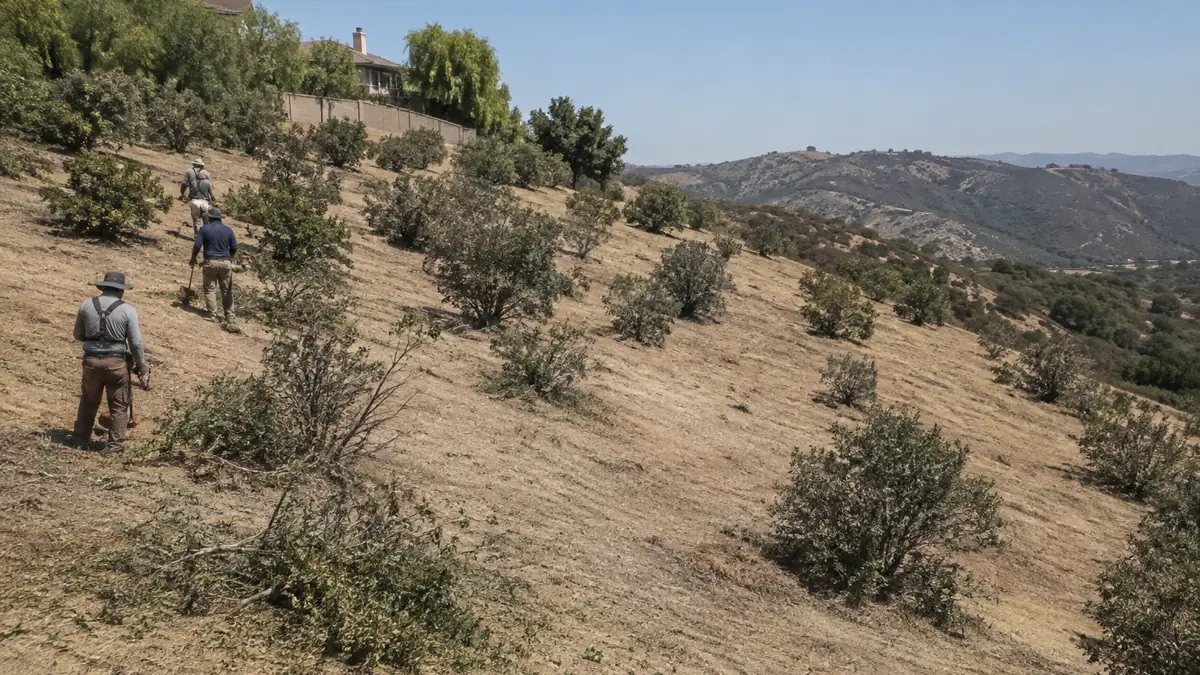
It is late October, the wind has been out of the northeast for two days, and you are standing at the back fence looking at a slope nobody has touched since spring. Those are the same hills that carried fire into these neighborhoods in November 2008.
Land clearing Yorba Linda homeowners genuinely need starts right at that fence line. This page covers who inspects here, what the Orange County Fire Authority looks for, how crews work a slope a truck cannot reach, and what the job costs on this terrain.
Who inspects defensible space in Yorba Linda?
Yorba Linda is served by the Orange County Fire Authority. OCFA runs its own defensible space and hazardous vegetation inspection program, separate from the Chino Valley Fire District that covers Chino Hills and Chino a few miles east.
OCFA inspectors work through hazard-zone neighborhoods on an annual cycle, document what fails and follow up. Deadlines and re-inspection windows are set year by year, so check the current-year schedule and requirements with the Orange County Fire Authority rather than relying on last season's date.
The state floor underneath the local program does not move. PRC 4291 requires 100 feet of defensible space around structures in fire hazard zones, measured out from the building or to the property line, whichever comes first.
What do OCFA defensible space inspections actually look at?
Inspections are about fuel, not tidiness. The items that fail most often on a hillside lot here are predictable:
- Dead material left inside living shrubs, because the interior of an old juniper or oleander carries a fuel load the green exterior hides
- Continuous brush running uphill into the structure with no break in it
- Limbs hanging over the roof, and branches within a few feet of eaves or a chimney
- Grass left tall and cured on the slope below the back fence
- Firewood, stored lumber and combustibles tucked under decks and against walls
The 100-foot zone is really two zones. The first 30 feet closest to the house is kept lean: spaced plants, nothing dead, nothing continuous. From 30 to 100 feet the work is thinning and separating, so fire drops out of the canopy and slows on the ground before it reaches the structure.
Why do these hills still matter after the Freeway Complex Fire?
In November 2008 the Freeway Complex Fire moved northeast on Santa Ana winds. It burned 30,305 acres, destroyed 187 homes and damaged 127 more across four counties, ran through Carbon Canyon into Chino Hills and Diamond Bar, and consumed roughly 95% of Chino Hills State Park.
The Yorba Linda neighborhoods that lost the most homes in that fire back onto the same hills today. That edge condition — houses on one side of a fence, open slope on the other — has not changed.
Chaparral regrows. A slope burned or cleared years ago carries a mature fuel load again now, and the wind pattern that drove that fire returns every fall. Clearing here is not a formality.
Which Yorba Linda properties need brush clearing most?
Any parcel with open slope behind it. In practice that means the hillside tracts on the north and east sides of the city, the lots adjoining Chino Hills State Park and the open corridor around it, and properties along the ridgelines where a back yard ends at a fence and the ground keeps going.
Equestrian and large-lot properties add their own exposure: arena edges, pasture margins, barn surrounds and the strip along a trail easement. Yorba Linda's trail system runs straight through fuel in a lot of places.
Slope aspect matters too. South- and west-facing slopes cure earlier and dry harder, so they carry dead standing fuel weeks before a north-facing slope on the same street does.
How do you clear a steep slope behind a Yorba Linda house?
From the top down, mostly by hand. That is what land clearing Yorba Linda hillside lots demand once the grade passes what a machine can safely hold. Crews work the slope with chainsaws, brush cutters and string trimmers, cutting standing fuel and pulling dead material out of live shrubs, then dragging cut material uphill to a chipper staged at the street.
Where the grade allows equipment, the economics change. A tractor with a flail mower or a skid steer with a brush cutter handles pads, fire roads and gentle slopes far faster than a crew can. A masticator earns its place on heavy woody stands, grinding brush into a chip layer that stays on site rather than leaving as tonnage.
The judgment call is where to stop cutting. Scalping a steep slope to bare dirt invites erosion the first hard rain after Santa Ana season. Root systems and low ground cover stay; dead material, ladder fuels and canopy continuity go. That is the difference between measured defensible space clearance and mowing everything down.
Fuel modification zones and defensible space are not the same thing
Many Yorba Linda tracts were approved with a fuel modification zone: an engineered band of managed vegetation between the development and the wildland, defined in the tract's approved plan and maintained permanently. That plan spells out which plants stay, which are prohibited, and how the zone is maintained.
Defensible space is the separate obligation measured out from your own structure. The two overlap on a hillside lot and they are enforced through different channels, which is why owners get confused when an association and a fire inspector ask for different things.
If your tract has a zone, fuel modification maintenance is annual, plan-driven work rather than a one-time cleanup. If it does not, the whole obligation lands on clearing the slope behind your own fence.
How much does land clearing Yorba Linda hillsides cost?
Hillside pricing is driven by access far more than by acreage. The factors that move a quote here:
- How much of the zone is hand work versus machine-accessible ground
- Slope angle, and whether the crew needs rope access to work it safely
- Fuel type, since cured grass is fast and mature sumac or juniper is slow
- Green waste tonnage, and how far the chipper has to sit from the cut
- Whether the parcel also carries a fuel modification plan with species requirements
- Red flag days and wind holds, which stretch a two-day job across a week
A standard back-slope clearance behind a tract home usually lands in the high hundreds to low thousands of dollars on typical Southern California hillside ground, and larger parcels or mature woody fuel go up from there. Any range only becomes real after somebody has stood on your slope.
What should you expect on clearing day?
Early starts are standard. Fire-safety guidance across Southern California is to run mowers and power equipment before 10 a.m., when fuel moisture is highest, and never to mow dry vegetation with a standard lawn mower.
Expect a chipper at the curb, chainsaw noise and dust on the downhill side. A back-slope job is usually one to two days; a large parcel or a full fuel modification zone reset takes longer.
Large clearing between roughly February 1 and August 31 falls inside nesting bird season. Coastal sage scrub and chaparral hold protected nesting species, so a pre-clearing survey may be required under state and federal bird protections before wide areas come down.
When the crew leaves, the slope should be thinned to plan, dead material gone, cut ends low, and debris hauled off — not stacked at the bottom of the hill where it becomes next season's fuel.
The canyon between Yorba Linda and the Chino Valley
Carbon Canyon Road climbs out of the hills above Yorba Linda and drops into Chino Hills, and it is one connected fuel system the whole way. The 2008 fire showed that ignition at one end reaches the other.
Our crews work both sides of that ridge. See how we handle the steep, narrow-access parcels in Carbon Canyon, or browse every community in the service area if you own property in more than one jurisdiction.
Book before the inspection notices go out
The best weeks fill early, and a slope is not a job to rush. Call for a free estimate on the land clearing Yorba Linda slopes need this season, or send the form below with your address and a note about slope access. We will walk it, mark where the clearance line falls, and quote the work in writing.
Questions from Yorba Linda property owners
When does OCFA inspect defensible space in Yorba Linda?
The Orange County Fire Authority inspects hazard-zone properties on an annual cycle, with deadlines and re-inspection windows set each year. Because those dates change, confirm the current-year schedule directly with OCFA rather than relying on a previous season. Booking clearing work before the notices go out is easier than scrambling after one arrives.
How far back from my house does the brush have to be cleared?
California's PRC 4291 requires 100 feet of defensible space around structures in fire hazard zones, or to the property line if that is closer. The first 30 feet is kept lean and free of dead material, and the outer 70 feet is thinned and separated so fire loses continuity before it reaches the structure. Local fuel modification plans can add further requirements.
Is clearing a fuel modification zone the same as defensible space work?
No. A fuel modification zone is an engineered band of managed vegetation established when a tract was approved, with a plan that dictates permitted and prohibited species and how the zone is maintained. Defensible space is the clearance measured out from your own structure. Hillside lots often carry both obligations at once, and they are enforced through different channels.
Can you clear a slope too steep to drive equipment onto?
Yes. Steep back slopes are worked by hand crews from the top down using chainsaws, brush cutters and string trimmers, with cut material dragged uphill to a chipper staged at the street. Machines are used only where a tractor or skid steer can hold the grade safely, which on most Yorba Linda hillside tracts means the pad and fire road rather than the slope face.