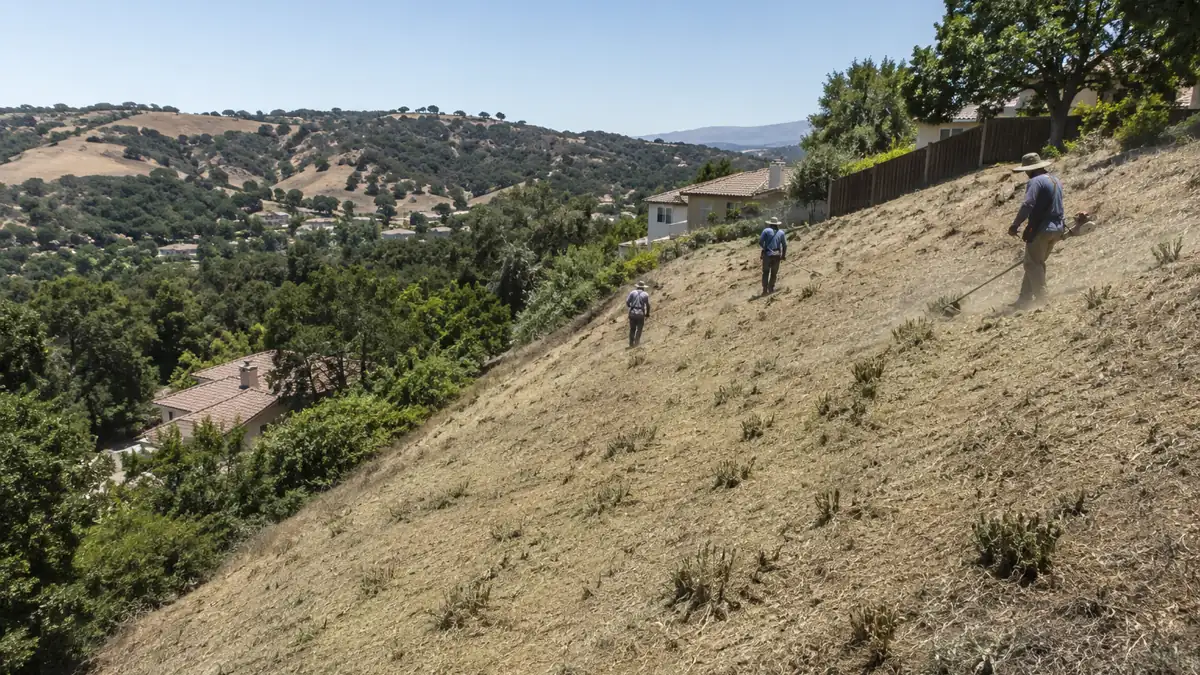
How does a crew cut brush on ground you cannot comfortably stand on? That question decides the price, the schedule, and the safety plan for every hillside brush clearing Chino Hills job we take. Half this city sits on grade, and the slope behind your back wall is usually the part of the property that matters most and gets ignored longest.
Below: how we decide between a machine and a hand crew, how to clear a slope without losing the soil off it, what the fire district expects, and what steep ground actually costs.
What does a hillside brush clearing Chino Hills job involve?
Slope work is the same fuel reduction as flat work, done under conditions that change every tool choice.
A hillside job usually includes:
- Cutting standing grass and brush low across the face of the slope
- Removing dead material out of live shrubs, which is where most of the flammable fuel actually sits
- Thinning solid stands into separated islands so fire cannot run uphill in an unbroken line
- Widening clearance along the top of the slope, closest to the structures
- Carrying or winching cut material uphill to a loading point, because gravity is not on your side
Fire climbs. Flame moves faster uphill than on flat ground, and a slope covered in cured grass acts like a chimney pointed at the houses on top of it. That is why the pad-level yard can look immaculate while the real exposure is the 40 feet of hillside nobody visits.
When can a machine work the slope, and when does it take a hand crew?
Grade decides. Gentle slopes take a tracked skid steer with a mulching head or a masticator, which grinds brush into chip in a single pass and covers ground fast. Once the grade gets steep enough that a machine could slide or roll, the job goes to a hand crew.
Hand crews run chainsaws, brush cutters, and string trimmers, working across the face rather than up and down it. It is slower and it costs more per square foot, and on much of the terrain in Vellano, Ridgegate, and the Carbon Canyon tracts it is the only responsible option.
Access matters as much as grade. A slope reachable only through a five-foot side gate is a hand job no matter how gentle it is. Some parcels get a hybrid plan: machine the top and the toe, hand crew the middle band.
Slope is simply the hardest version of land clearing, and it gets priced that way. The same acre of fuel costs far less to cut on flat valley ground than it does on a grade.
We make that call standing on the lot, not on a satellite image.
How do you clear a slope without losing the soil?
The mistake that costs homeowners the most is scalping. A hillside stripped to bare dirt in June sheds mud into the yard, the pool, and the street during the first real storm, and the repair costs far more than the clearing did.
Good slope work cuts rather than pulls. Crews leave root systems, low ground cover, and any established native plants that hold soil, then remove the dead material and break up the fuel continuity above them.
Cutting height gets managed too. Vegetation cut low but left rooted keeps a living mat on the hill. Chip left in a thin layer holds moisture and slows runoff, though it is kept off the immediate zone around structures where it would become fuel.
The goal is a slope that is hard to burn and still hard to move.
What does the fire district expect from hillside parcels?
Hillside owners answer to the same calendar as everyone else. The Chino Valley Fire District requires combustible vegetation cleared by May 5, and a parcel still hazardous at the June 11 reinspection draws a $300 non-compliance penalty plus a $328 administration fee if the district's contractor has to do the work.
On top of that, California's defensible space law requires 100 feet of clearance around structures in designated hazard zones, and on a downhill lot most of that 100 feet is slope. Properties inside the Chino Hills Fire Hazard Overlay District carry extra requirements, including grass mowed to four inches or less and dead vegetation removed.
Check your current program dates and requirements with the Chino Valley Fire District. We work to those published standards, but we do not speak for the district and we cannot promise how an inspector will call your lot.
What affects the cost of clearing a slope?
The hillside brush clearing Chino Hills slopes need costs more than flat ground, for reasons that show up on every invoice.
- Grade. The steeper it gets, the more of the work shifts from machine hours to labor hours.
- Access points. Where the truck parks decides how far every armload of material travels.
- Vegetation type. Cured annual grass is fast. Mature laurel sumac and old woody stands are slow and heavy.
- Haul versus chip. Chipping on the slope avoids hauling weight uphill. Full removal costs more but leaves nothing behind.
- Crew size and safety setup. Rope work, spotters, and heat rules on a south-facing slope all add hours.
- Wind days. Red flag conditions stop powered equipment, and rescheduled crews compress into the next open window.
Hillside clearing in this region commonly runs about $1,500 to $5,000 per acre, with steep hand-crew-only parcels at the top of that band and machine-accessible slopes near the bottom. Small residential back slopes are usually quoted per job, not per acre.
What does a day on a steep lot look like?
Crews start at first light. Fire district guidance is to run mowers and trimmers before 10 a.m., and on hot, dry, windy days powered equipment shuts down entirely. Slope work also has a heat ceiling, so afternoons in July get cut short on purpose.
Expect saw noise, a chipper running at the top of the slope, and dust. Material comes uphill in loads, gets staged on the pad, and leaves in a truck.
Most residential back slopes take one to two days. Large canyon-side parcels take longer, especially where the crew is working a narrow band at a time.
When we leave, the slope is cut low and evenly thinned, dead wood is gone, the ground still has roots holding it, and the 100 feet closest to your structure is the cleanest part of the hill.
Slope owners usually pair this with structure-focused defensible space work at the top of the grade, and parcels on the wildland edge often carry an ongoing fuel modification zone further out.
See what changes for hillside tracts in Chino Hills and for the Yorba Linda slopes backing onto the same hills. Call or use the contact form and we will walk the slope with you.
Common questions about hillside clearing
How steep is too steep for machines?
There is no single number, because it depends on the machine, the operator, the soil moisture, and whether the ground is rutted or rocky. As a working rule, once a person cannot walk the slope comfortably without using hands, it is hand crew territory. We decide on site and we do not put an operator on ground we do not trust.
Will clearing my hillside cause erosion?
Not if it is cut rather than scraped. Leaving root systems and low ground cover in place keeps the soil bound while still removing the fuel. Erosion problems come from grubbing a slope to bare dirt, which is why we cut and thin instead of stripping the hillside.
How much of my slope has to be cleared?
Start from the structures and measure out. California's defensible space standard calls for 100 feet around structures in designated hazard zones, and on a downhill lot most of that falls on the slope. If your property line ends before 100 feet, you clear to the line and the neighboring owner handles their side.
Can you reach a slope with no gate access?
Usually yes, on foot. Crews carry saws and trimmers in, cut in bands, and move material out by hand to the nearest staging point. It costs more than a machine-accessible job, but a landlocked back slope is one of the most common conditions on hillside streets here and it gets cleared regularly.
How often does a hillside need clearing?
Once a year for most properties, done in spring ahead of the May deadline. After a heavy rain year, fast-growing annual grass on a south-facing slope can justify a second cut in early summer. Slopes that skip a year get expensive, because a season of woody regrowth turns a mow back into a brush job.