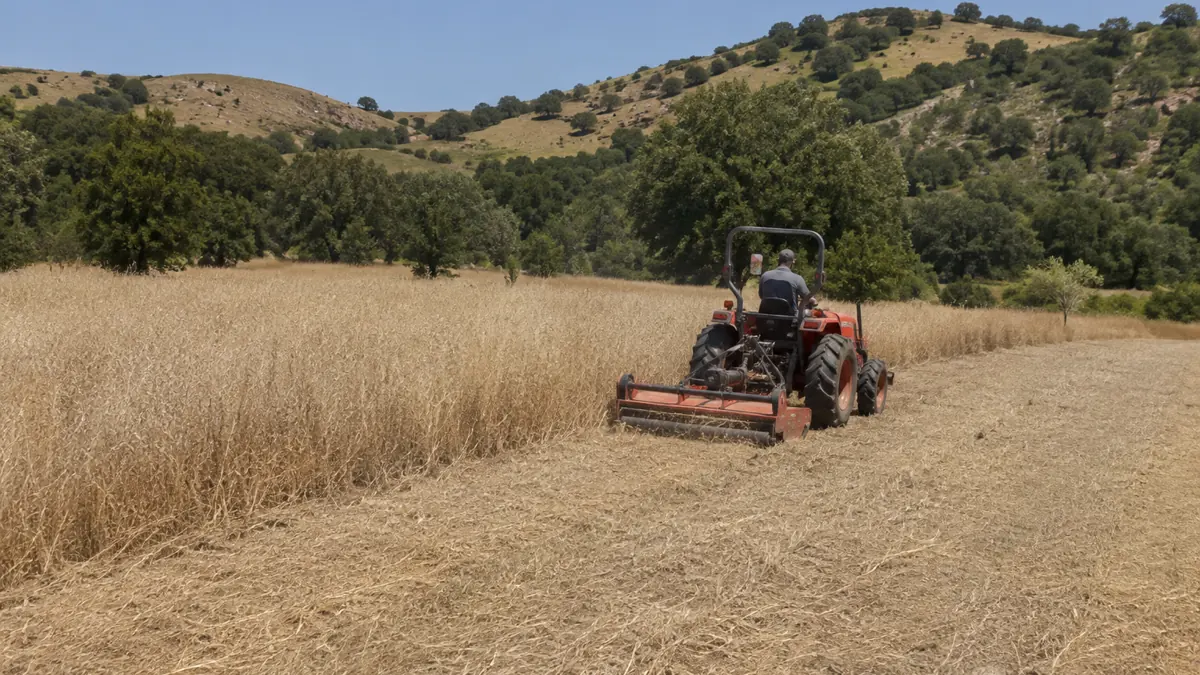
An envelope shows up with your parcel number on it, a date, and a line about combustible vegetation. The side lot has not been touched since the rains stopped, the grass is past your knee, and suddenly there is a deadline attached to your weekend.
That envelope is what sends most people looking for weed abatement mowing Chino Hills crews can schedule quickly. Below you will find who sends the notice, what the fire district wants to see when it comes back, what mowing and discing cost around the Chino Valley, and how a parcel gets cleared in one visit.
How does weed abatement mowing Chino Hills work, start to finish?
Abatement work is volume cutting. The crew knocks standing grass and weeds down to a short, uniform height across the whole parcel so there is nothing tall and cured left to carry a fire.
The usual toolkit:
- Tractor with a flail mower or brush hog for open acreage
- Discing on larger flat parcels, where the ground gets turned so the fuel is buried instead of laid down
- Walk-behind mowers and string trimmers for fence lines, corners, meters, and the ground around structures
- Optional haul-off when the cut material is heavy enough to matter
Mowing and discing are not interchangeable. Mowing leaves a stubble field and a mat of cut material, which is fine for most residential lots. Discing turns the soil into a bare firebreak, which suits big open parcels and fire break lines but is wrong for erosive slopes and anything with irrigation or hardscape hidden in the weeds.
How do you know your parcel is due for abatement?
The clearest signal is a notice in the mail from the fire district with an inspection date on it. Do not wait for that. Once the district has to chase you, the calendar shortens and the cost of being late goes up.
Other signs the parcel is past due:
- Grass is past knee height in May and already going gold at the tips
- Tumbleweed is stacking against fences and gates
- Neighbors have started calling the city about a vacant lot next door
- Weeds are touching a shed, a fence, a propane tank, or a parked trailer
- An escrow or a new insurance policy is asking for the lot to be cleared before it funds
If two or more of those are true, the parcel needs a cut now rather than in June.
Who sets the deadline, and what do the fines cost?
The Chino Valley Fire District runs the annual weed abatement program for Chino Hills and Chino, and its dates are the ones that matter here. Combustible vegetation must be cleared by May 5.
Parcels still hazardous at the June 11 reinspection get a $300 non-compliance penalty. If the district's own contractor has to go out and clear the parcel, the owner is billed the clearance cost on top of a $328 administration fee, which is why a scheduled mow is nearly always the cheaper path.
Program dates and amounts are set each year, so confirm the current cycle with the Chino Valley Fire District before you plan around them. We follow the district's published standards. We are not part of the district and cannot speak for its inspectors.
What changes the price of mowing or discing a parcel?
Abatement pricing tracks acreage first and obstacles second.
- Size. Per-acre cost drops as the parcel gets bigger, because setup and trailer time gets spread over more ground.
- Access. A locked gate too narrow for a tractor turns a machine job into a walk-behind job and multiplies the hours.
- What is hiding in the grass. Rock, rebar, dumped tires, curbing, and irrigation heads all slow a mower down and can cost a blade.
- Slope. Anything a tractor cannot safely hold has to be trimmed by hand.
- Disposal. Mowing in place costs less than cutting and hauling, because tonnage and dump weight get added to the bill.
- Timing. Red flag days and Santa Ana wind events pause powered equipment and push schedules tight against the deadline.
Straightforward tractor mowing in this region commonly runs about $250 to $700 per acre, with small residential side lots often quoted flat in the $200 to $500 range. Discing generally sits at the higher end. Heavy overgrowth that needs cutting before it can be mowed is quoted separately after we see it.
What does mowing day look like on your lot?
Crews start early on purpose. Fire district guidance is to run mowers and trimmers before 10 a.m., when fuel moisture is highest and wind is lightest, and never to mow dry vegetation with a lawn mower.
Expect engine noise for a couple of hours and a lot of dust on a dry parcel. Powered equipment carries spark arrestors and the truck carries water. On a red flag day the machines stay off and the work moves.
Most residential lots finish in a morning. An acre or two of open ground usually takes a half day. When we leave, the parcel is cut low and even, edges and fence lines are trimmed, and anything we agreed to haul is gone rather than raked into a corner.
Keep the invoice and a dated photo of the cleared lot. If a reinspection notice shows up anyway, that record makes the conversation short.
Which parcels around the valley do we mow?
The weed abatement mowing Chino Hills parcels need changes with the terrain. Flat acreage on the valley floor and hillside lots on the town's edges take different machines, so we quote them differently. See the local detail for abatement work around Chino Hills and for the equestrian and vacant parcels in Chino.
A cut is often only half the job. Homes with structures inside a hazard zone also need clearance work measured out from the walls, and undeveloped land heading toward a build usually needs deeper land clearing services rather than a seasonal mow.
Send us your parcel number and a photo of the notice through the contact form, or call and we will get you on the schedule before the deadline crowd fills it.
Common questions about weed abatement
How short does the grass have to be cut?
Inside the Chino Hills Fire Hazard Overlay District the guidance is grass mowed to four inches or less, with dead vegetation removed. A standard abatement mow targets that height across the whole parcel, including corners and fence lines where tall grass usually survives a careless cut.
Do I need mowing or discing on my property?
Mowing suits most residential and mid-size lots, and it leaves the root mat holding the soil. Discing suits large, flat, open parcels where a bare soil break is the goal. Discing is a poor choice on slopes, on ground with buried irrigation, or where erosion is already a problem.
What happens if I miss the May 5 deadline?
Your parcel goes into reinspection. A property still found hazardous at the June 11 reinspection draws a $300 non-compliance penalty, and if the district's contractor performs the clearing, you are billed for that work plus a $328 administration fee. Getting cut before the deadline avoids all of it.
Do you haul away the cut material?
We can, and on heavy parcels you usually want to. A standard mow leaves the cut material laid down in place, which the district generally accepts on mowed lots. Thick woody debris, tumbleweed piles, and dumped trash are different, and those get loaded and taken to a green waste facility.
How far ahead should I book an abatement mow?
Two to four weeks in April, more if you are booking the week before the deadline. Every parcel in the valley is on the same calendar, so the last two weeks of April are the busiest stretch of the year. Booking in March gets you a better date and a calmer crew schedule.