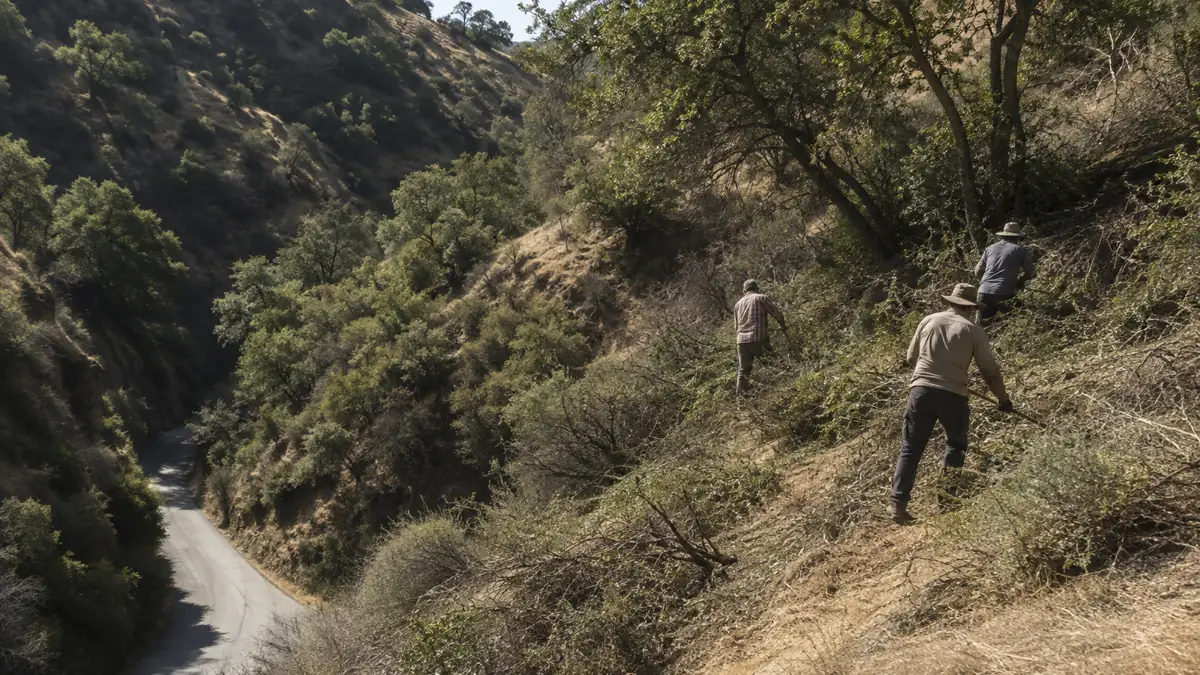
This canyon has burned twice in living memory along the same corridor: a major fire in 1990, and again in 2008 when the Freeway Complex Fire ran the canyon from the Orange County side into Chino Hills and Diamond Bar.
Carbon Canyon land clearing exists because of that pattern. This page covers the canyon communities strung along Carbon Canyon Road (SR-142) — Sleepy Hollow, Western Hills, Canyon Hills and the scattered parcels between them — where steep ground and narrow access decide how the work gets done.
Why is Carbon Canyon land clearing different from the rest of the valley?
Carbon Canyon is one road through a narrow drainage, with houses built on the slopes above and below it. Parcels stack up the canyon walls, driveways drop away from the pavement, and there is rarely a flat staging spot within a hundred feet of the work.
That geometry rules out most machines. A tractor cannot turn on a canyon shelf, a chipper truck cannot back down a switchback driveway, and a skid steer on a steep sidehill is a rollover waiting to happen.
It also concentrates the risk. SR-142 is the way in and the way out for many of these homes. Fire behavior in a chimney like this one is fast and wind-driven, and cleared ground is what stands between a running fire and a structure.
What does the fire history here tell you?
This corridor burns. It carried a major fire in 1990, and in 2008 the Freeway Complex Fire came through again — 30,305 acres burned, 187 homes destroyed and 127 more damaged across four counties, with roughly 95% of Chino Hills State Park consumed.
That fire ran the canyon into Chino Hills and Diamond Bar. The same fuel beds regrew afterward. Chaparral in this part of Southern California returns to burnable density within about a decade, which means a slope last cleared years ago is carrying a full load again today.
What are canyon property owners required to clear?
Canyon parcels on the Chino Hills side sit inside the city's Fire Hazard Overlay District, which layers extra requirements on top of the state rule. California's PRC 4291 sets the baseline at 100 feet of defensible space around structures in fire hazard zones.
The overlay adds specifics that bite on a canyon lot: grass mowed to four inches or less, dead palm fronds removed, dead vegetation cleared out, leaves and pine needles off roofs and out of gutters, and combustibles pulled from under decks — and canyon homes have a lot of deck.
Deadlines on the Chino Hills side follow the Chino Valley Fire District calendar: cleared by May 5, reinspection in June, with a non-compliance penalty and an administration fee if the district's contractor has to do the work. Verify current program-year dates and amounts with the Chino Valley Fire District.
How do you clear a canyon lot with no truck access?
By hand, from the top down. Crews cut with chainsaws, brush cutters and string trimmers, pull dead material out of live shrubs, and drag everything uphill to the nearest point a chipper can legally park along SR-142.
That last part is the constraint most bidders miss. Carbon Canyon land clearing gets planned around where a chipper can legally park, because the road is narrow, with blind curves and very little shoulder. A crew that has worked this canyon knows which turnouts are usable and which ones earn a citation.
The work itself is slope and hillside clearing in its purest form, wrapped around a measured defensible space clearance out from the structure. Where the lot runs into open chaparral, the outer zone gets thinned rather than scalped — the goal is broken fuel continuity, not bare dirt on an erodible slope.
How do you keep a canyon parcel clear year after year?
Clearing a canyon lot once is a project. Keeping it clear is maintenance, and maintenance is cheaper. Fire break and fuel modification work establishes a maintained band of reduced fuel between the wildland edge and the structures, then holds it at that condition on an annual cycle.
Erosion is the reason to be careful about how much comes off. Stripping a steep canyon slope to soil trades a fire problem for a mud problem, so root systems stay in the ground and low ground cover stays where it holds the hill. Thinning, limbing up and removing dead material does more for fire behavior than scraping ever does.
Timing matters here as well. Large clearing between roughly February 1 and August 31 falls inside nesting bird season, and canyon chaparral is prime habitat, so a pre-clearing survey may be required under state and federal bird protections.
The canyon spans two counties — which rules apply to you?
The corridor runs from Chino Hills in San Bernardino County west into Brea in Orange County, and it connects the Chino Valley to the Yorba Linda hills. Which agency inspects your parcel depends on which side of the line the property sits on, so check your parcel address before you assume a deadline.
If your property is on the Chino Hills side, the city's hillside and overlay-district requirements apply to you as well. If you are over the ridge toward the Orange County hills, read how Orange County Fire Authority inspections work instead.
Our crews handle brush clearing and fuel-break work along the whole corridor. See every community in the service area for the full list.
Schedule a canyon walk-through
Canyon jobs take longer to schedule because they take longer to do, and the good weeks fill first. Call for a free estimate, or send the form below with your address and a note about driveway access. We will walk the parcel, show you where the clearance line falls, and quote the hand work honestly.
Questions from Carbon Canyon property owners
Do canyon parcels need hand crews instead of machines?
Usually, yes. Most Carbon Canyon lots are too steep and too narrow for a tractor or skid steer to work safely, and there is often nowhere to stage equipment.
Crews cut by hand from the top down and drag material up to a chipper parked in a usable turnout along Carbon Canyon Road. Machine work is limited to the few parcels with a flat pad or a fire road.
How much of a canyon slope has to be cleared?
California's PRC 4291 requires 100 feet of defensible space around structures in fire hazard zones, measured out from the building or to the property line, whichever comes first. On the Chino Hills side of the canyon, Fire Hazard Overlay District rules add requirements for grass height, dead vegetation, roof and gutter debris, and combustibles stored under decks.
Will clearing my canyon slope cause erosion?
It can if the slope is stripped to bare soil. Proper canyon clearing thins and separates fuel instead of removing everything: dead material, ladder fuels and canopy continuity come out, while root systems and low ground cover stay in place to hold the hillside through winter rain.