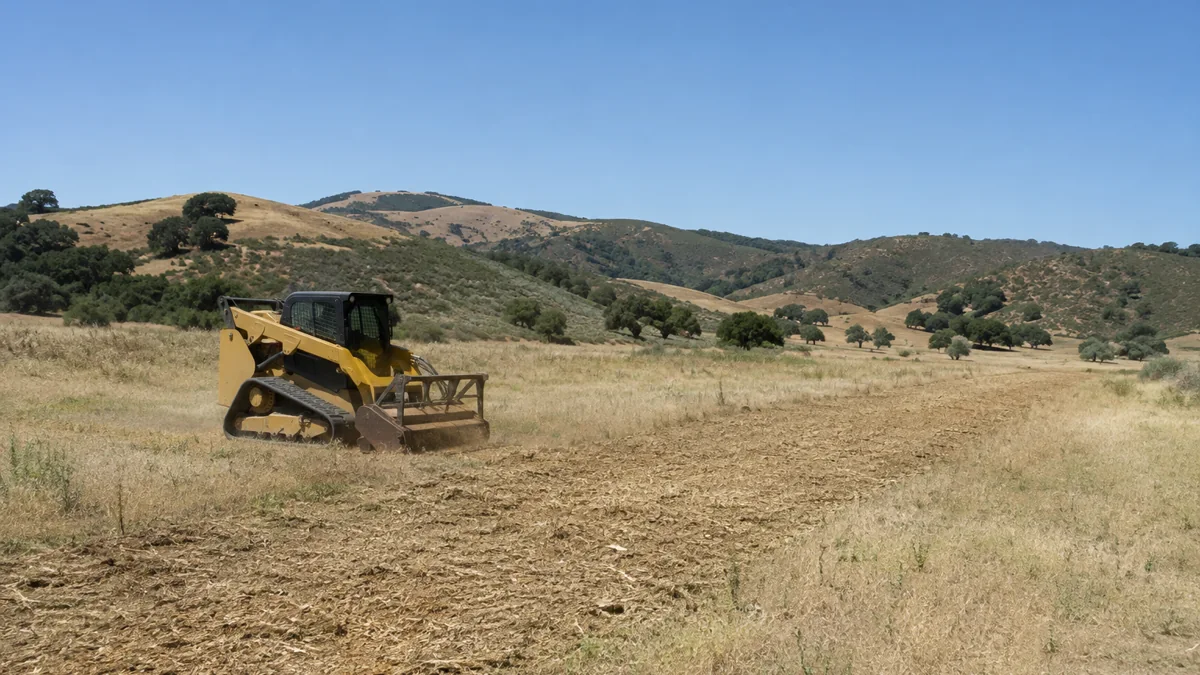
You inherited a parcel off a frontage road, or you bought land years ago and left it alone. Now there is a fence full of tumbleweed, somebody has been dumping mattresses at the gate, a neighbor has started calling the city, and escrow on the sale is asking for photos of clean ground.
That sequence is how most lot clearing Chino Valley property owners order gets started. Here is what clearing a vacant parcel actually involves, who enforces the rules on undeveloped land, what pre-construction work adds, and what an acre costs.
What does a lot clearing Chino Valley project cover?
Lot clearing is whole-parcel work rather than yard work. It is the land clearing services end of the trade, and the scope scales with what you plan to do with the ground.
- Seasonal compliance clearing. Mow or disc the whole parcel, trim the perimeter, cut back growth off fences and gates.
- Reclaim clearing. Cut out multi-year brush, remove tumbleweed piles, and haul off dumped debris so the ground is usable again.
- Pre-construction clearing. Strip vegetation, grub roots and stumps where the pad and utilities go, and leave clean, workable ground for a surveyor or grading contractor.
Most parcels here fall in the first two categories. A five-acre field off Pipeline or a half-acre infill lot between houses needs the same decisions: cut or turn the soil, leave the material or haul it, and how clean the ground has to be when we are done.
Tell us the end goal, whether that is passing an inspection, closing a sale, or breaking ground, and the scope follows from there.
When does a vacant parcel need clearing?
Vacant land generates its own problems, and the warning signs are consistent:
- An abatement notice arrives from the fire district with an inspection date
- Weeds and grass ran past knee height in May and cured brown
- Tumbleweed is piled against fences, gates, and the neighbor's block wall
- Neighbors are complaining, or the city has already been out
- Someone is dumping on the parcel because it looks abandoned
- An escrow, a lender, or an insurance carrier wants the lot cleared before it will move forward
The escrow trigger is the expensive one. A clearing job that could have been scheduled at your convenience in March turns into a rush job in the middle of a 30-day close, and rush pricing is real.
Vacant parcels are also the ones fire inspectors flag first, because nobody lives there to notice the fuel building up.
How is pre-construction clearing different from a seasonal cut?
A compliance mow removes fuel. Pre-construction land clearing services remove the vegetation and everything under it.
That means grubbing roots and stumps in the building footprint, taking out old fence posts, irrigation lines, and concrete, and hauling everything off rather than laying it down. The ground has to be clean enough for a survey crew to shoot grades and for a grading contractor to start without fighting root balls.
Timing matters more here too. This valley has a lot of legacy dairy preserve land converting into housing and logistics, especially along the 71 corridor and the Chino side of the valley, and those projects run on schedules that do not care about weather.
We coordinate around utility locates, keep haul routes off residential streets where we can, and stay clear of survey stakes.
We handle vegetation and debris. Grading, compaction, and export dirt belong to a grading contractor, and we will tell you plainly where our scope stops.
Who enforces vegetation rules on vacant land?
The Chino Valley Fire District runs the annual weed abatement program for Chino Hills and Chino, and vacant parcels sit near the top of its list. Undeveloped land has to be clear of combustible vegetation by May 5, same as an occupied lot.
A parcel still hazardous at the June 11 reinspection gets a $300 non-compliance penalty. If the district's contractor clears the land, the owner is billed for that clearing plus a $328 administration fee.
Owners who live out of the area often find out about all of it from a bill rather than a notice, because the mail chases the address on the tax roll.
City code enforcement can also act on dumping, blight, and overgrowth complaints separately from the fire program. Confirm your parcel's current requirements with the Chino Valley Fire District before the spring cycle starts.
What drives lot clearing cost per acre?
For lot clearing Chino Valley owners are pricing out, acreage sets the floor. Everything else moves the number.
- Density. Open grass is a mow. Multi-year brush and volunteer trees are a cutting job before anything can be mowed.
- Slope and terrain. Flat valley ground takes machines. Rolling parcels on the hillside edges slow everything down.
- Access. Gate width, road frontage, and where a dump trailer can turn around all change the hours.
- Debris load. Dumped tires, mattresses, and construction waste get separated and disposed of at different rates than green waste.
- Disposal. Leaving material in place is cheapest. Hauling is priced on tonnage and dump weight.
- Depth of clearing. Grubbing roots and stumps costs multiples of a surface cut.
Straightforward vacant lot clearing in the Inland Empire commonly runs about $800 to $3,500 per acre, with light annual grass at the bottom and heavy brush with full haul-off well above it. Pre-construction grubbing is quoted separately after a walk-through.
What does clearing day look like on a vacant parcel?
We start early. Fire district guidance is to run mowers and trimmers before 10 a.m., and never to mow dry vegetation with a lawn mower. On red flag days powered equipment stays off entirely, which is worth knowing if you are running against a deadline.
Machines work the open ground while a hand crew handles fence lines, gate areas, corners, and anything close to a structure or utility box. Debris gets sorted as it is loaded so green waste goes to a recycler rather than straight into a landfill.
An acre of open grass is usually a half day. A neglected multi-acre parcel with heavy brush and dumped debris can take several days.
When we finish, the parcel is cut low and even, the perimeter is trimmed, dumped material is gone, and gates and frontage are clear. For seasonal compliance most owners just need a scheduled abatement mow each spring, and heavy parcels usually need green waste hauling priced alongside the clearing.
We work parcels from the hillside edges of Chino Hills to the flat acreage and equestrian land in Chino. Send your parcel number through the contact form or call, and we will price it from a site visit.
Common questions about lot clearing
How much does it cost to clear a one-acre lot?
In this region a straightforward one-acre parcel of annual grass and light weeds commonly falls in the $800 to $2,000 range, while an acre of heavy brush with debris and full haul-off runs higher. Access, slope, and disposal weight move the number more than acreage does, so any real quote comes after a site visit.
Do you clear lots for owners who live out of the area?
Yes, and it is a large share of vacant land work here. We walk the parcel, send photos and a written scope, then send before and after photos with the invoice. That photo record is what most out-of-area owners need for their fire district file, their lender, or their escrow.
Do I need a permit to clear my lot?
Routine vegetation clearing and abatement mowing generally do not require one. Grading, tree removal, and work touching drainage or protected habitat can. Check with the City of Chino Hills or the City of Chino for your parcel before a pre-construction clearing job, since the answer depends on zoning and what you are removing.
What happens to the debris you remove?
Green waste goes to a recycling or composting facility rather than a landfill wherever the load is clean enough to accept. Trash, tires, and construction debris are separated on site and disposed of through the right channel. Loads with mixed trash tangled into brush cost more because the sorting is manual.
Can you clear a lot in the middle of escrow?
Usually yes, though spring is the tightest window because every parcel in the valley is on the same abatement calendar. Tell us the closing date when you call. If we cannot hit it, we will say so instead of booking you and hoping.